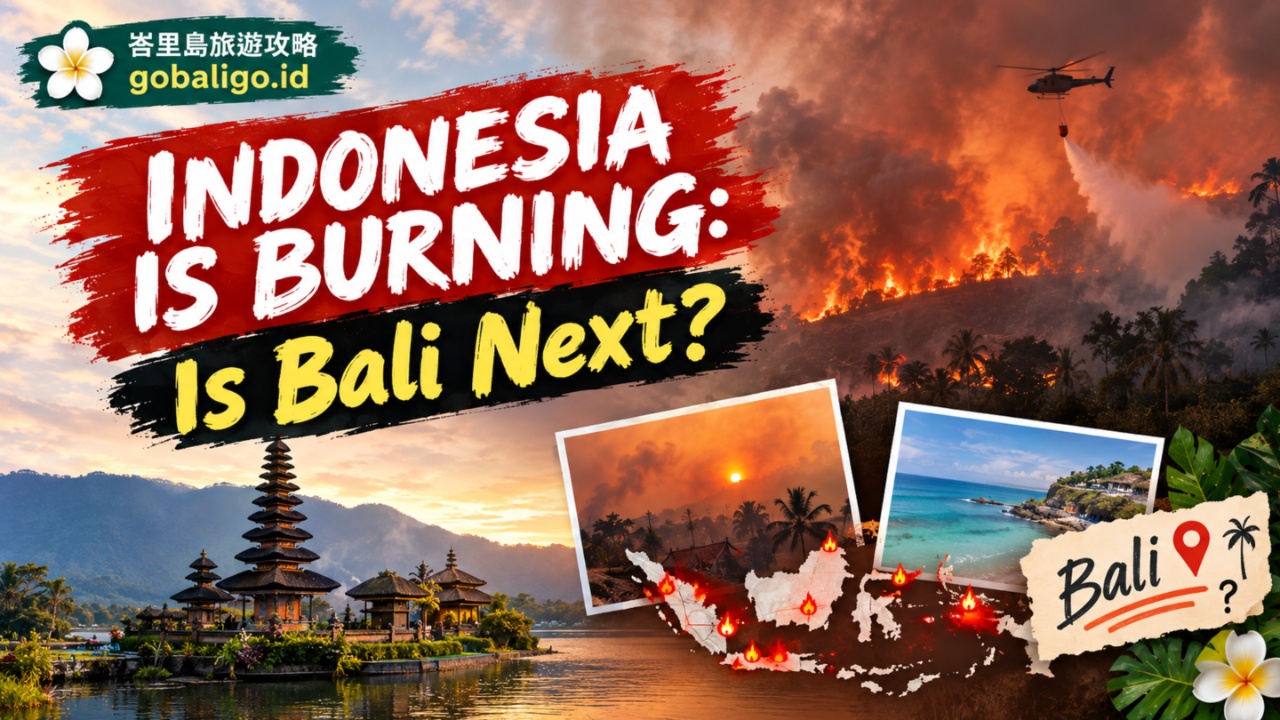
Let’s cut to the chase: The haze from Indonesia’s wildfires has been making big headlines lately, but Bali hasn’t been significantly affected, so there’s no need to cancel your trip.
News reports have been covering it daily: Kalimantan’s air quality index is off the charts, Singapore is handing out masks, and schools in Malaysia are closed. Many travelers heading to Bali are asking if it’s the same there. I’ve gone through the latest data and compiled it here.
Kalimantan: The fires are truly severe
The source is in Central and West Kalimantan. On October 14, air quality in these two provinces reached hazardous levels, with the capital Palangkaraya’s index exceeding 1,000—far above Indonesia’s official hazardous threshold of 300.
On October 19, several cities and districts in Central and South Kalimantan still had indices ranging from 306 to 713. Indonesia’s Ministry of Health reported that from August 18 to October 13, there were over 280,000 cases of respiratory infections.
Some background:
- Reuters calls this Indonesia’s worst forest fire season in 11 years.
- This year’s dry season coincides with a strong El Niño, bringing less rain and making fires harder to extinguish.
- Many hotspots are in peatlands, smoldering underground for weeks. The surface may look clear, but smoke keeps rising.
- Nationwide high-confidence hotspots dropped from 1,085 on October 12 to 270 on October 17—a downward trend, but far from over.
Where the Wind Blows, the Smoke Follows
This season brings southeast winds, pushing the haze mainly northwest. The European Union’s Copernicus Atmosphere Monitoring Service predicts the same: most smoke drifts north and west toward the Malay Peninsula and the South China Sea, not toward Java.
The haze travels far, no doubt. The Philippines and Timor-Leste have been affected, with Timor-Leste even closing schools nationwide for three days.
Jakarta’s situation is unique. Satellite images from Indonesia’s meteorological agency show smoke has reached Jakarta’s skies, but at altitudes of 2 to 3 kilometers, without settling to the ground. Later, a few monitoring stations in Jakarta and West Java recorded unhealthy indices, though the agency noted it’s still unclear how much the smoke impacts ground-level air.
Wind direction isn’t fixed. Singapore’s environmental agency expects winds to shift to southeast by east from the evening of October 20, potentially blowing Kalimantan’s haze back toward Singapore.
Singapore and Malaysia: Clearly Under the Haze
These two countries are hit hardest. Here are the numbers:
| Location | Data | Date |
|---|---|---|
| Singapore | Western 24-hour PSI 230, highest this year | October 18, 10 AM |
| Singapore | PSI 88 to 114, significant improvement | October 19, 6 PM |
| Singapore | Forecast PSI 90 to 160, haze may return on the 20th evening | October 20 forecast |
| Malaysia | 27 areas unhealthy, highest at Pasir Gudang, Johor: API 177 | October 14, 9 AM |
| Malaysia | National highest at Batu Pahat, Johor: API 197 | October 7, 9 AM |
I couldn’t find the latest nationwide data for Malaysia on October 19 and 20, so the figures above are the most recent confirmed ones. Different countries use different indices—PSI, API, ISPU, and the US AQI each have their own calculations and thresholds, so the numbers can’t be directly compared.
Bali: Air Quality Is Fine for Now
Bali lies southeast of Kalimantan, directly opposite the direction the haze is drifting. The actual data backs this up:
- Indonesia’s Ministry of Environment reported on October 16 that the air quality index (ISPU) in Java was mostly good to moderate, and Bali’s situation is similar.
- The current US AQI in Seminyak is 87, which falls in the moderate range. Forecasts show 43 for today, 40 for Wednesday, and 50 for Thursday—all within the good range.
As for that 87 reading, I can’t say for sure whether it’s from the wildfires. Last September (2025), before this round of forest fires, Bali also recorded a moderate reading of 91, which was actually the highest in all of Indonesia at the time. So moderate readings aren’t unusual for Bali.
The only area worth keeping an eye on is East Java. Fires are also being fought near Bromo National Park, which is closer than Kalimantan, so it’s worth checking if the wind direction shifts.
What to Do If You’re Heading to Bali
Just stick with your travel plans. A day before you leave and on the morning of your departure, take a quick look at the local AQI and wind direction—that should be enough.
Travelers with asthma, heart or lung conditions, or those traveling with children and elderly family members should pack an extra mask just in case. When air quality is poor, try to limit prolonged outdoor activities.
If your itinerary includes a transit in Singapore or a stop in Kuala Lumpur, keep a close eye on the latest updates from local environmental agencies over the next few days, as the haze could drift back with the wind.
Popular Outdoor Activities in Bali
- Hot Air Balloon Ride with Stunning Views of Mount Agung
- 11 Seafood Restaurants in Jimbaran, Bali: No-Fail Picks
- Jungle Cart Bali: Mario Kart in Ubud's Jungle
- Bali Bird Park Interactive Experience
- No Need to Wake Up Early: Sunset Jeep Tour
- Kuta Beach Surfing Lesson
- Bali White Water Rafting Guide: Common Questions Answered
- Campuhan Ridge Walk: Ubud's Skywalk Trail
- Ubud Adventure Must-Do: UTV Off-Road + Rafting/Swing Full Experience
- Water Activities Deals on Klook
Sources
- Tempo: Kalimantan Haze
- ETtoday: Indonesia’s Orange Haze
- Kompas: Palangka Raya Air Quality
- Kompas: Prabowo-Gibran’s Two Years and the Haze
- CNBC Indonesia: ISPU Update
- Jakarta Post: Haze Reaches Jakarta
- HK01: Haze Spreads to Jakarta
- AsiaOne: Singapore Haze and Wind Direction
- Wikipedia: 2026 Southeast Asian haze
- The Sun: Malaysia API (October 14)
- Malay Mail: Malaysia API (October 7)
- Malay Mail: Peatland Fires
- Guancha: Southeast Asian Haze
- Databoks: Bali Air Quality Index, September 2025


No discussions yet — be the first to ask.